
My Research

Nanomaterials | Thin Films | Photocatalysis

A Sustainable Future Through Nanotechnology

In our quest for a sustainable future, the role of technology, especially in harnessing solar energy, cannot be overstated. It's a clean, inexhaustible source of power that holds the key to mitigating our global energy crisis. As we tap into this celestial bounty, we also unlock the magical wonders of Nanotechnology—a field where the minuscule meets the mighty, and where innovation thrives at the atomic level.

Nanotechnology has the potential to revolutionize how we gather, store, and use solar energy, making it more efficient and widely accessible. It's a realm where materials behave in ways that challenge our traditional understanding, offering new solutions to old problems. From self-cleaning solar panels to more effective energy storage systems, the applications are as vast as they are promising.

As a scientist deeply immersed in this field, I am thrilled to share these advancements with enthusiasts, students, and fellow researchers. It's a journey of discovery, where each breakthrough brings us closer to a greener planet. Through this platform, I aim to demystify the complexities of nanotechnology and solar energy, fostering a community where knowledge is not just acquired but shared and expanded upon. Together, let's explore these sustainable technologies and their potential to shape a better world.

Scientific logo

Publications

My Publications in Nanotechnology #

Within the dynamic and transformative field of nanotechnology, my research carves out a niche in the development of advanced photocatalysts. My publications offer a deep dive into the innovative use of nanomaterials for environmental applications, with a focus on visible-light-driven photocatalysis. This work is at the forefront of addressing global challenges in water treatment and sustainable energy production.

The articles listed here detail my journey through the intricacies of thin-film technology and physical vapor deposition techniques, showcasing how these methods can be harnessed to create efficient and cost-effective solutions for purifying water and harnessing solar energy. Each publication not only contributes to the scientific community but also paves the way for real-world applications that can make a tangible difference in people's lives.

I invite you to explore my body of work, which stands as a testament to the potential of nanotechnology to revolutionize our approach to environmental stewardship and energy utilization. Through collaboration and continued research, we can unlock the secrets of the nanoscale to build a cleaner, greener, and more energy-efficient future.


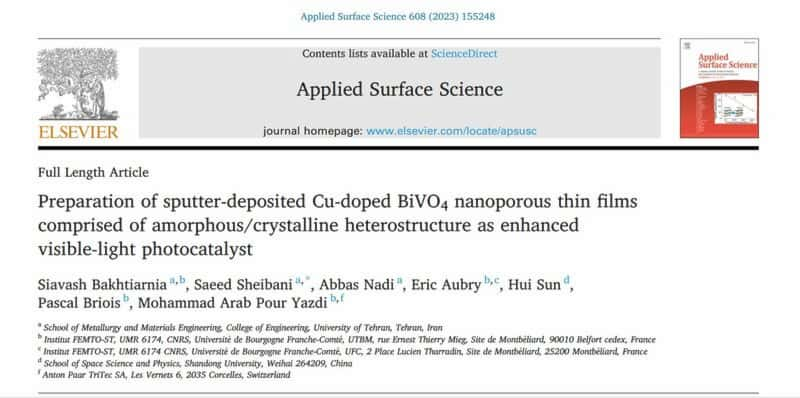
Preparation of sputter-deposited Cu-doped BiVO4 nanoporous thin films comprised of amorphous/crystalline
        heterostructure as enhanced visible-light photocatalyst (2023)

Preparation of sputter-deposited Cu-doped BiVO4 nanoporous thin films comprised of amorphous/crystalline heterostructure as enhanced visible-light photocatalyst (2023)

Siavash Bakhtiarnia, Saeed Sheibani, Abbas Nadi, Eric Aubry, Hui Sun, Pascal Briois, Mohammad Arab Pour Yazdi.
Applied Surface Science, Volume 608, 2023, 155248.

This article explores sputter-deposited Cu-doped BiVO4 nanoporous thin films with an amorphous/crystalline heterostructure, demonstrating their enhanced visible-light photocatalytic activity.

Read the Article
One-step preparation of Ag-incorporated BiVO4 thin films: plasmon-heterostructure effect in photocatalytic
        activity enhancement (2022)

One-step preparation of Ag-incorporated BiVO4 thin films: plasmon-heterostructure effect in photocatalytic activity enhancement (2022)

Siavash Bakhtiarnia, Saeed Sheibani, Eric Aubry, Hui Sun, Pascal Briois, Mohammad Arab Pour Yazdi.
Applied Surface Science, 580, 2022, 152253.

This article describes a one-step method for preparing Ag-incorporated BiVO4 thin films and investigates the role of the plasmon-heterostructure effect in enhancing their photocatalytic activity.

Read the Article
Deposition of nanoporous BiVO4 thin-film photocatalyst by reactive magnetron sputtering: Effect of total
        pressure and substrate (2022)

Deposition of nanoporous BiVO4 thin-film photocatalyst by reactive magnetron sputtering: Effect of total pressure and substrate (2022)

Siavash Bakhtiarnia, Saeed Sheibani, Alain Billard, Eric Aubry, Mohammad Arab Pour Yazdi.
Transactions of Nonferrous Metals Society of China, 32, 2022, 957–971.

This article explores the effect of total pressure and substrate on the deposition of nanoporous BiVO4 thin-film photocatalyst using reactive magnetron sputtering.

Read the Article
Enhanced photocatalytic activity of sputter-deposited nanoporous BiVO4 thin films by controlling film
        thickness (2021)

Enhanced photocatalytic activity of sputter-deposited nanoporous BiVO4 thin films by controlling film thickness (2021)

Siavash Bakhtiarnia, Saeed Sheibani, Alain Billard, Hui Sun, Eric Aubry, Mohammad Arab Pour Yazdi.
Journal of Alloys and Compounds, 879, 2021, 160463.

This article explores the impact of film thickness on the photocatalytic activity of sputter-deposited nanoporous BiVO4 thin films.

Read the Article
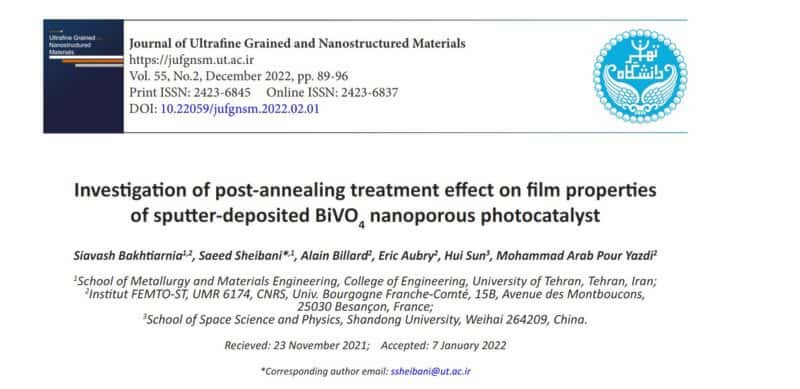
Investigation of post-annealing treatment effect on film properties of sputter-deposited BiVO4 nanoporous photocatalyst

Investigation of post-annealing treatment effect on film properties of sputter-deposited BiVO4 nanoporous photocatalyst (2022)

Siavash Bakhtiarnia, Saeed Sheibani, Alain Billard, Eric Aubry, Hui Sun, Mohammad Arab Pour Yazdi.
Journal of Ultrafine Grained and Nanostructured, Vol. 55, 2022, No.2, pp. 89-96

This article explores the impact of post-annealing on nanoporous BiVO4 thin films, investigating how annealing temperature affects their structure and photocatalytic properties.

Read the Article
article logo

Article

Nanotechnology illustration

An Introduction to Nanotechnology and Its Current Impact

Nanotechnology is a groundbreaking field that explores and manipulates matter at the atomic and molecular scale, unlocking extraordinary capabilities in medicine, energy, electronics, and environmental solutions. This article offers an accessible yet informative introduction to what nanotechnology is, why nanomaterials behave so uniquely, where they are being applied today, and what the future may hold for this fast-evolving science.

Read the Article
article logo

Article

Nanotechnology illustration

Overview of Nanomaterials Synthesis Methods

Nanomaterials can be produced through a wide range of synthesis strategies, each offering different levels of control, cost, and scalability. This article introduces the major families of these methods in an accessible way, covering top-down approaches such as milling and lithography, bottom-up physical and chemical routes like CVD, PVD, sol–gel, and hydrothermal synthesis, as well as biological, green, and template-assisted techniques. Because different applications require different forms—nanoparticles, thin films, nanowires, or ordered arrays—the choice of method depends on factors like precision, purity, environmental impact, and the intended use. By outlining how each technique works and comparing their strengths and limitations, the article provides a practical framework for understanding and selecting suitable nanomaterial synthesis pathways.

Read the Article
article logo

Article

solar energy

Solar Energy: Technologies, Status, and Future Prospects

Solar energy has rapidly evolved from a niche option to a cornerstone of the global energy transition. This article explains how sunlight is converted into electricity, heat and fuels—through photovoltaics, solar thermal technologies and emerging solar-to-hydrogen pathways—before outlining today’s global deployment and solar’s role in power systems. It then highlights key research frontiers, from perovskite–silicon tandem cells to advanced solar fuel concepts, and explores scenarios in which solar becomes the dominant source of electricity in a net-zero world. Finally, it examines the practical challenges of variability, land use, materials and equity, and the innovations needed for solar to reach its full potential.

Read the Article
article logo

Article

environmental remediation

Nanotechnology in Environmental Remediation: From Smart Materials to Cleaner Water, Air, and Soil

Nanotechnology offers practical, high-impact tools for addressing some of our most persistent environmental challenges. Many contaminants—whether in water, air, or soil—exist in tiny concentrations that conventional technologies struggle to capture or break down efficiently. By engineering materials at the nanoscale, where surface area, reactivity, and selectivity are dramatically enhanced, it becomes possible to remove pollutants more effectively, catalytically degrade harmful compounds, and monitor contamination in real time. This article provides a clear overview of how nanotechnology is being applied to environmental remediation, the mechanisms that make it effective, and the emerging innovations shaping cleaner, more resilient systems.

Read the Article